Kwikstage Scaffolding Quality Control: A 2026 Factory Audit & Inspection Checklist for Importers
Kwikstage scaffolding quality control guide for 2026 importers: audit steel grades, welds, HDG, load tests, and request a secure quote before shipment.
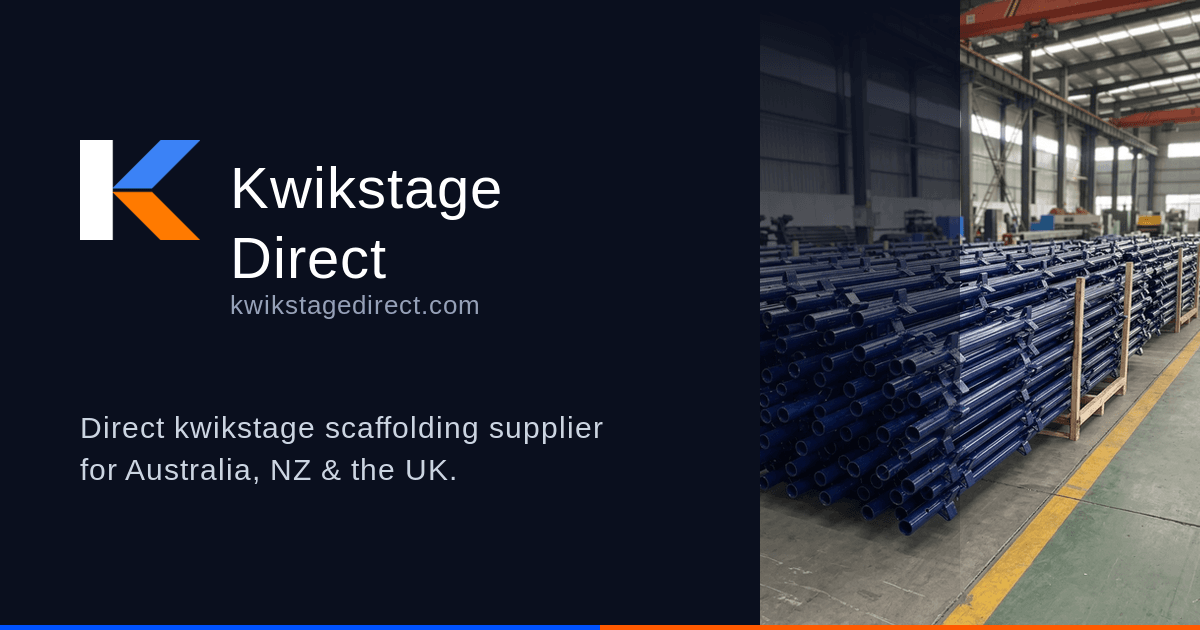
For global procurement teams, distributors, and large-scale scaffolding contractors, importing Kwikstage scaffolding represents a massive capital expenditure. More importantly, it represents a profound assumption of liability. When a 20-story temporary access structure relies entirely on the structural integrity of imported steel tubes, V-pressings, and captive wedges, there is zero margin for error. The difference between a profitable, long-lasting scaffold fleet and a catastrophic failure on site often comes down to a single factor: Quality Control (QC) at the point of manufacture.
In 2026, the global supply chain for scaffolding is more complex than ever. While many factories offer highly competitive pricing, the temptation to cut corners to offset rising freight and raw material costs is ever-present. This practical guide provides procurement managers and site engineers with the ultimate factory audit blueprint. By enforcing these exact standards, you can confidently import Kwikstage scaffolding that can be specified against named international frameworks such as EN 12811 and AS/NZS 1576 when those frameworks apply, while ensuring a multi-decade operational lifespan for your fleet.
Scope note: This is a 2026 buyer-side factory audit framework for global importers, not a substitute for project engineering calculations, statutory site inspections, or a local engineer of record. Treat the numeric tolerances below as purchase-order acceptance criteria unless a certified design, regional standard, or site authority requires a stricter value.
1. The Foundation: Raw Material Traceability and Steel Grade Verification
Before a single cut or weld is made, the quality of the scaffolding is already determined by the steel coil sitting in the factory yard. The majority of Kwikstage scaffolding is manufactured using either Q235 (S235) or Q345 (S355) structural carbon steel. Kwikstage standards (the vertical load-bearing members) generally utilize high-yield Q345 steel to resist buckling, while ledgers and transoms often use Q235. For the grade-selection trade-offs before RFQ, compare the buyer criteria in our Q235 vs Q345 Kwikstage sourcing guide.
The Negative Tolerance Trap: One of the most common tricks employed by sub-standard manufacturers is manipulating negative tolerance. A factory might quote a 48.3mm outer diameter (OD) tube with a 4.0mm wall thickness. However, Chinese national steel standards permit a degree of negative tolerance. An unethical supplier might purchase steel that is actually 3.6mm thick, drastically reducing the steel weight and their cost, but entirely invalidating the engineered load capacity of the scaffold system.
Audit Action:During your factory audit or third-party Pre-Production Inspection (PPI), you must manually verify wall thickness using calibrated digital ultrasonic thickness gauges. Furthermore, you must demand the original Mill Test Certificates (MTCs). An MTC traces the specific heat number of the steel coil back to the primary steel mill (e.g., Baosteel, Ansteel), proving both the chemical composition (Carbon, Manganese, Silicon, Sulfur, Phosphorus) and the mechanical properties (Yield Strength, Tensile Strength, Elongation).
2. Precision Engineering: Dimensional Accuracy and System Compatibility
Kwikstage is defined by its modular simplicity: a standard with V-pressings (star clusters) welded at precise 495mm (or 500mm depending on regional spec) intervals, and ledgers/transoms with captive wedges that drop securely into these pressings. If the dimensional accuracy is off by even a few millimeters, the system will not assemble correctly on site.
Pitch Interval Accuracy: The distance between the V-pressings dictates the entire geometry of the scaffold structure. If the factory's welding jigs are worn out or poorly calibrated, a standard might have a cumulative error. For example, an error of 1mm per node over a 3-meter standard results in a 6mm misalignment at the top. When multiplied across a 50-meter long facade, the scaffolding will physically twist, making it impossible to install platforms or toe boards safely.
Wedge and V-Pressing Tolerances: The captive wedge must slide smoothly into the V-pressing. If the pressing is too tight, scaffolders will be forced to aggressively hammer the wedge, causing premature wear, localized work-hardening, and eventual fracturing. If the fit is too loose, the scaffold node will lack rigidity, leading to a swaying, unsafe structure. If wedge fit is your main supplier risk, review the failure modes in our wedge and V-pressing quality guidebefore approving production.
Audit Action:Your inspection checklist must include a physical fit-up test. Select random standards, ledgers, and transoms directly off the production line. Erect a 3x3x3 bay tower. Measure the diagonals to ensure perfect squareness. Verify that a single hammer blow is sufficient to lock the wedge, and that a single reverse blow can dislodge it.
3. Welding Quality and ISO 3834 Conformance
The integrity of a Kwikstage node relies entirely on the weld connecting the V-pressing to the vertical standard. Scaffolding is subjected to extreme dynamic forces: wind loads, worker movement, heavy material loading, and impact shocks. A poorly welded V-pressing can shear completely off the standard, triggering a progressive collapse of the entire scaffold structure.
Automated vs. Manual Welding: Leading manufacturers utilize robotic welding lines equipped with CO2 shielded arc welding (MAG welding). Robotic welding ensures a perfectly consistent bead, precise heat input, and deep penetration. Manual welding, while cheaper, is subject to human fatigue, leading to inconsistent weld profiles, porosity, and slag inclusions.
The Danger of Undercutting: If the welding voltage is too high or the travel speed is too fast, the weld pool can burn away part of the parent tube wall (the standard). This is known as "undercutting." A 4.0mm tube undercut by 1.0mm at the weld joint is suddenly reduced to 3.0mm of effective thickness exactly at the point of maximum stress. This is a fatal defect.
Audit Action:Your audit must verify that the factory holds active ISO 3834 certification. During In-Line Inspections (DUPRO), inspectors must visually examine welds for spatters, porosity, and undercutting using a welding gauge. Furthermore, destructive testing should be performed: a V-pressing should be subjected to a hydraulic shear test until failure. The failure must occur in the parent metal or the pressing itself, never tearing purely through the weld seam.
4. Hot-Dip Galvanizing (HDG) to ISO 1461
While some buyers still opt for dip-painted Kwikstage for short-term budget reasons, Hot-Dip Galvanizing is the overwhelming choice for serious fleet managers due to its 15-30 year lifespan and zero maintenance requirements. However, simply requesting "HDG" is not enough; the galvanizing process is fraught with potential QC failures. For the commercial trade-off, see the comparison of HDG vs painted Kwikstage scaffolding.
Coating Thickness and Adhesion: For scaffolding tubes, ISO 1461 defines local and mean coating-thickness requirements by article thickness, so the purchase order should cite the applicable table value for the tube and pressing gauge rather than a generic "HDG" note. In practical audits, inspect both local minimum and batch average readings; thin spots at wedges, ledger ends, and drain holes are the usual rejection points. If the steel is not properly pickled (cleaned in acid) before dipping, the zinc will not form the critical metallurgical alloy layers with the steel, leading to flaking upon impact.
Wedge Fusion: A common disaster in Kwikstage manufacturing occurs when the molten zinc solidifies and fuses the captive wedge to the ledger end. Factories must implement mechanical vibration or spinning immediately after dipping to shake off excess zinc before it hardens.
Audit Action:Pre-Shipment Inspections (PSI) must involve random Elcometer (magnetic thickness gauge) testing across various points of the scaffolding to verify zinc depth. Furthermore, every single wedge must be physically struck to ensure it is completely free and operational before packing.
5. Load Capacity Testing: EN 12811 and AS/NZS 1576 Compliance
Procurement is ultimately about buying performance, not just steel. The performance of scaffolding is defined by its Safe Working Load (SWL). This is validated through rigorous physical testing in accordance with regional standards like EN 12811-1 (Europe) or AS/NZS 1576.1 (Australasia).
A factory claiming compliance must be able to produce legitimate, verifiable third-party testing reports. These tests include:
- Standard Buckling Tests: Subjecting a 3-meter standard to immense vertical compression until it buckles to determine the ultimate load capacity.
- Node Stiffness Tests: Measuring how much the ledger-to-standard connection rotates under moment forces. A rigid node is essential for the stability of un-braced facades.
- Transom Bending Tests: Applying a central point load to a transom to ensure it can support the weight of scaffold boards loaded with bricks and mortar without permanent deflection.
Audit Action:Never accept in-house testing reports at face value. Demand reports from internationally accredited testing laboratories. Verify the report numbers directly with the testing laboratory's online portal to ensure they have not been forged or altered.
6. The Complete 2026 Procurement QC Audit Checklist
Use the following structured matrix to build your vendor evaluation and third-party inspection mandate. Do not issue a Letter of Credit (LC) or final balance payment until an independent inspection agency confirms every row is marked as a Pass.
| Audit Phase | Inspection Item | Required Standard / Metric | Testing Method |
|---|---|---|---|
| Pre-Production | Raw Material Steel Grade | Q235 (Ledgers) / Q345 (Standards) | Mill Test Certificate (MTC) + Spectrometer Test |
| Wall Thickness Tolerance | Max -5% of nominal (e.g. 3.8mm for 4.0mm) | Digital Ultrasonic Thickness Gauge | |
| In-Line (DUPRO) | Welding Quality | ISO 3834, zero undercutting, full penetration | Visual + Welding Gauge + Random Destructive Shear |
| Dimensional Accuracy (Pitch) | 495mm (or regional spec) ± 1.0mm per node | Calibrated steel tape over 3+ meters | |
| System Fit-Up | Smooth wedge engagement, square structure | Physical erection of 3x3x3 bay tower | |
| Pre-Shipment | HDG Coating Thickness | ISO 1461 local/mean thickness for the material gauge | Elcometer Magnetic Gauge Sampling |
| Wedge Mobility | 100% of wedges must drop and lock freely | Manual strike test on random pallets |
Procurement Execution Checklist
- ☐Specify exact steel grades (e.g., Q345) and exact wall thicknesses in the PO.
- ☐Explicitly state that negative tolerance below 5% will result in shipment rejection.
- ☐Mandate ISO 3834 welding compliance and ISO 1461 HDG standards in the contract.
- ☐Hire a recognized third-party agency (SGS, Intertek) to execute the audit matrix above.
- ☐Verify third-party EN 12811 or AS/NZS 1576 load testing certificates with the issuing lab.
7. Reference Standards for Importers
Ensure your engineering and legal teams are familiar with the following regulatory and manufacturing frameworks to protect your liability:
- ISO 3834-2:2021: Quality requirements for fusion welding of metallic materials — Part 2: Comprehensive quality requirements.
- EN 12811-1:2003: Temporary works equipment - Scaffolds - Performance requirements and general design. The benchmark for European scaffolding load and structural integrity.
- AS/NZS 1576.1:2019: Scaffolding General Requirements. Critical for the heavily regulated Australian and New Zealand construction sectors.
Source with Absolute Confidence
You don't need to fly across the world to ensure your scaffolding is built to last. At Kwikstage Direct, our manufacturing process inherently passes every metric on this audit checklist. We provide full traceability, certified load testing, and uncompromised Q345 steel.
Contact Our Engineering Desk for a Secure Quote
Strictly compliant with EN 12811 and AS/NZS 1576 standards.