Kwikstage DirectKwikstage Direct
  • Compatibility
  • About
  • Insights
Open email app
WhatsApp
Kwikstage DirectKwikstage Direct

Kwikstage Direct is a direct kwikstage scaffold supplier for Australia, New Zealand, and the UK. Enquire about kwikstage standards, ledgers, transoms, steel planks, and compatible system supply by email.

Email

[email protected]
Open email app
Commercial Pages
  • Acrow props
  • House scaffolding
  • Standards
Buyer Topics
  • Ledgers & transoms
  • Steel planks
  • Galvanized kwikstage
  • Compatibility
Company
  • About
  • Contact
  • Insights
Legal
  • Cookie Policy
  • Privacy Policy
  • Terms Of Service
© 2026 Kwikstage Direct. All Rights Reserved.
house scaffolding2 story house scaffoldingfull house scaffolding2 bay scaffold5 bay scaffoldHybrid tool + reportSnapshot: reviewed March 27, 2026

Need a fast answer for house scaffolding, 2 story house scaffolding, 5 bay scaffold, or a smaller bay-led residential shortcut?

House scaffolding packages for 5 bay scaffold, 2 story house scaffolding, and full-wrap access.

Use the tool first when the query starts as house scaffolding, 2 story house scaffolding, full house scaffolding, or a bay-led shortcut such as 1 bay, 2 bay, or 5 bay scaffold. The same canonical page turns frontage, straight-run bay length, lifts, duty, access, finish, and height band into a usable house-scaffold brief, then explains the compliance, access-equipment, and sourcing limits before you email.

Start the house scaffold briefSee the evidence
If the search started as house scaffolding, this same canonical page is the intended answer. The tool starts from a recoverable residential brief, then shows when the job still behaves like spot access and when it already needs a wider house-wrap conversation.
If the search started as 2 story house scaffolding, stay on this same canonical route. The dedicated two-storey preset keeps the URL unified while showing where a front-elevation scaffold is still a clean shortcut and where it already needs wrap, access-equipment, or compliance review.
If the search started as 5 bay scaffold, stay on this same canonical route. The dedicated five-bay preset turns the alias into a wider-frontage brief, then shows when the job still behaves like a clean multi-bay run and when it has already moved into wrap, stair-access, or design-sensitive coordination.
Published March 21, 2026Last updated March 27, 2026

14

public sources reviewed

3

markets compared

6

intent variants on one route

Reviewed against public guidance and manufacturer sources

Safe Work Australia duties toolSafe Work Australia housing falls guideSafe Work Australia falls model codeWorkSafe NZ working at height guideHSE scaffolds guidanceHSE assessing work at heightWaco safe-use guide

If the brief is already blocked by component geometry, open kwikstage standards, ledgers and transoms, or the compatibility guide before you email.

Tool-first

Start from the house brief, frontage, and height band before you read the report layer.

Boundary-led

The result tells you when a two-storey shortcut is no longer enough and needs a fuller scaffold or alternative access path.

Action-ready

Every result state ends in a next email action, not a dead-end label.
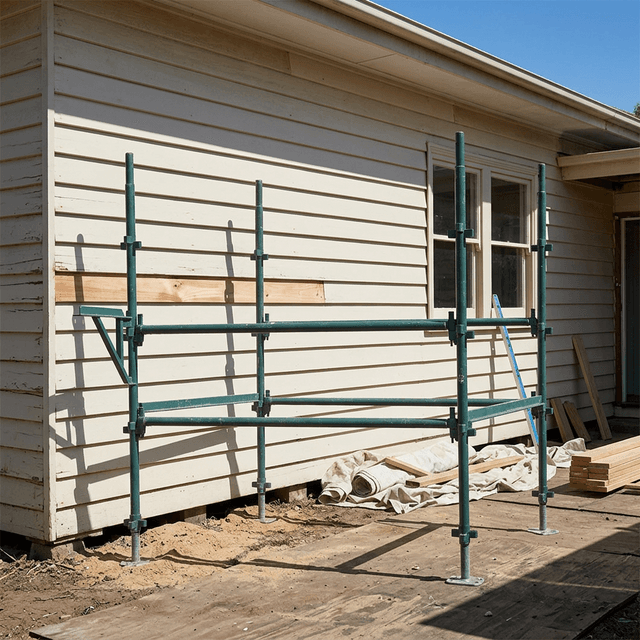
Residential kwikstage scaffold setup around a weatherboard house renovation

Visual context

Two-storey and five-bay briefs are still package conversations

Built for Australia, New Zealand, and UK buyers who need a fast house-scaffolding starting point for two-storey facades, roof-edge work, and full wraps without pretending that storey count alone means one fixed component list, one legal pathway, or one delivered quote.

2 bay / 2 lift house briefStorey count is only the first layer.
Tool layerhouse scaffolding2 story house scaffolding5 bay scaffoldSummaryEvidenceComparisonMethodologyRisksFAQ

Tool layer

House scaffolding brief builder

Start here if the search began as house scaffolding, 2 story house scaffolding, or 5 bay scaffold.

Quick presets

Keep it between 1 and 12. A 5 bay scaffold query is still a commercial scope input, not a design calculation.

Use working lifts, not total storeys. Extra lifts change the brief quickly.

Waco's public Kwikstage brochure lists assembled ledger-transom lengths at about 2.39m, 2.64m, 2.88m, and 3.12m. If you are not sure which module applies, leave it unconfirmed and let the result show the public range.

Approximate working level only. Australia and New Zealand do not use exactly the same legal height measurement.

This tool is deliberately a brief builder. It helps you decide whether the page can still answer the house-scaffolding query directly, or whether height, duty, compatibility, or access already force the discussion into a tighter quote path.

The key boundary is that height band is a triage shortcut rather than a universal legal measurement, and heavy duty is not the same as a loading platform or other special-duty scaffold. If the brief is UK-based, state the intended load rating in the email instead of assuming the AU/NZ bay-load shorthand applies unchanged.

For a 5 bay scaffold query, the missing variable is usually the straight-run bay length. Waco's published ledger-transom modules mean five bays can still span materially different frontage even before stairs, corners, or wraps are counted.

Safe Work Australia falls model codeWorkSafe NZ scaffolding guideHSE scaffolds guidanceWaco Kwikstage brochure
Open email app

This path sends the current filled inputs only. Run the tool first if you want the email to include the result and next action.

Ready to run

The default path answers the 2 story house scaffolding alias first, and the 5 bay scaffold preset handles the wider multi-bay shortcut.

Run the brief builder to see whether your house-scaffolding request still behaves like a simple starter or whether a two-storey, five-bay, or full-wrap brief should already move into a tighter coordination path. The straight-run bay-length field is there because five bays can still mean very different frontage once the published module length is named.

Report summary

The page can answer a 2 story house scaffolding or 5 bay scaffold shortcut quickly, but the buying decision only stays clean while you keep duty, height, access, and compatibility in view at the same time.

The cards below compress the live tool logic, regulator guidance, and manufacturer examples into the numbers, access comparisons, and boundary rules that actually change the next action.

Two-storey trigger
A 2 story house shortcut can cross a compliance threshold quickly

Residential house scaffolding often reaches the same 4m to 5m discussion much sooner than the keyword suggests. Australia separates the >2m SWMS trigger from the >4m licensing trigger, New Zealand uses a 5m highest-component test plus over-5m notification, and the UK keeps inspection and design handling live from the start.

Safe Work Australia duties toolWorkSafe NZ scaffolding guideHSE scaffolds guidance

Reviewed March 27, 2026

Access path
House scaffold, tower scaffold, and MEWP do not solve the same problem

HSE and Safe Work Australia both treat equipment choice as a planning decision. A narrow repair may fit a tower or MEWP, but repeated facade access, roof-edge work, or a wider two-storey wrap usually needs a platform that protects the whole work area rather than a point-access shortcut.

HSE assessing work at heightHSE tower scaffolds guidanceSafe Work Australia housing falls guide

Reviewed March 27, 2026

Duty classes
Bay loads in AU/NZ, duty rating in UK

Australia and New Zealand publish 225 / 450 / 675 kg per bay duty classes, while HSE public guidance frames UK duty rating by load per square metre. Buyers should not port one shorthand across all three markets.

Safe Work Australia general guideWorkSafe NZ scaffolding guideHSE scaffolds guidance

Reviewed March 27, 2026

5 bay meaning
Five bays can still mean roughly 12.0m to 15.6m of straight run

Waco’s public Kwikstage brochure lists assembled ledger-transom lengths at about 2.39m, 2.64m, 2.88m, and 3.12m. A five-bay inquiry therefore still needs the run-module length before frontage, truck space, or tie planning are treated as known.

Waco Kwikstage brochure

Reviewed March 27, 2026

Australia
>4m licence + 30-day checks

Safe Work Australia separates the high-risk licence trigger from the >2m SWMS trigger, and its falls model code also calls for competent-person inspection before first use and at least every 30 days for scaffolds with a >4m fall risk.

Safe Work Australia duties toolSafe Work Australia falls model code

Reviewed March 27, 2026

New Zealand
5m is two different tests

WorkSafe NZ measures competency from the highest scaffold component and also treats scaffolding over 5m as notifiable work, so the build-up matters more than the shorthand query.

WorkSafe NZ scaffolding guide

Reviewed March 27, 2026

United Kingdom
7-day checks + design gate

HSE expects inspection before first use, every 7 days, and after events that could affect safety; once a system scaffold moves outside recognised manufacturer guidance, a design route is expected.

HSE scaffolds guidanceHSE scaffold FAQ

Reviewed March 27, 2026

Quote-ready brief
Boarded lifts, loads, access, and extras

HSE explicitly asks for boarded lifts, maximum working loads, access type, sheeting or netting, supporting structure, and tie restrictions before a proper scaffold design process can start. Bay count alone is not a specification.

HSE scaffolds guidance

Reviewed March 27, 2026

Top-up orders
System markings and compatibility matter

WorkSafe NZ says supplier and system type should be permanently identified on scaffold components, and Waco does not permit mixing prefabricated systems unless the supplier approves compatibility.

WorkSafe NZ scaffolding guideWaco safe-use guide

Reviewed March 27, 2026

Roof-edge counterexample
Single-storey roof work can still need the same protection logic

WorkSafe NZ says single-storey dwellings need the same process for deciding controls as two-storey dwellings, so roof pitch, brittle materials, and edge exposure matter more than the storey label alone.

WorkSafe NZ roof work guide

Reviewed March 27, 2026

Access alternative
A tower or MEWP only works while the task stays point-access

HSE treats tower scaffolds as a trained, inspected platform with strict movement limits, and WorkSafe NZ says if workers leave a MEWP and step onto the roof directly, scaffold or edge protection is still required.

HSE tower scaffolds guidanceWorkSafe NZ roof work guide

Reviewed March 27, 2026

Suitable / not enough fit
Use the tool result to decide whether the page can still carry the job as a commercial shortcut.

Suitable

  • A buyer who genuinely needs a house-scaffolding starting brief for a spot repair, two-storey front elevation, or wider wrap and understands the result is quote-prep, not design sign-off.
  • A commercial discussion where access path, duty class, and market trigger are still being narrowed before component reconciliation.
  • A package inquiry where the next right action is an email with a cleaner residential brief, not a shopping-cart checkout.

Not sufficient

  • Anyone expecting a certified bill of materials, tie pattern, or engineering sign-off from a public page.
  • Projects where the main question is structural capacity, exact wrap geometry, or site-specific tie design.
  • A compatibility-sensitive top-up where the existing fleet geometry has not yet been described or shown.
Known now vs still needs confirmation
The report layer builds trust by separating what the page can say publicly from what still belongs in an actual project brief.

Swipe horizontally to see every column.

LayerKnown nowStill confirm directly
Known on-pageDuty class ranges, market threshold triggers, access-equipment trade-offs, common component families, and when a two-storey house scaffold brief remains commercially simple.Exact frontage, board count, tie pattern, brace count, and site-specific design checks still need direct confirmation.
Known from tool inputBay count, lift count, height band, access preference, finish preference, and whether the request still behaves like a spot-access brief or already needs coordination.Delivered freight logic, exact component reconciliation, and whether stock-match or lift usage crosses a manufacturer or engineering boundary.
Known from official guidanceAustralia uses >4m and >2m triggers differently and adds 30-day inspections, New Zealand splits 5m competence from notifiable work, and UK guidance uses duty ratings per m² plus inspection and manufacturer-led design limits.Exact project drawings, tie spacing, leg loads, any engineered departures, and final legal responsibility still belong in project-specific compliance review.
Known from the reviewed source setHSE publishes UK duty ratings at 0.75 / 2.0 / 3.0 kN/m² and separate tower-scaffold guidance, Safe Work Australia and WorkSafe NZ separate special duty from the fixed 225 / 450 / 675 kg per bay classes, and Waco publishes tie, lift, stair, and base-set examples for Kwikstage.There is still no reliable public dataset for supplier-ready BOMs, delivered freight, finish-life predictions, or cross-brand compatibility approvals on a live yard.

Evidence layer

The report stays narrow on purpose: only the public numbers, definitions, and manufacturer examples that materially change a house-scaffolding buying decision are included here.

Duty-class table
Public duty numbers are still the clearest way to stop a two-storey shortcut from being treated as one universal workload.

Swipe horizontally to see every column.

DutyLoadTypical widthUse signal
Light dutyUp to 225kg per bayApprox. 450mm platform widthPainting, electrical work, and other lighter trade tasks.
Medium dutyUp to 450kg per bayApprox. 900mm platform widthGeneral trades work, tiling, and lighter framing tasks.
Heavy dutyUp to 675kg per bayApprox. 1000mm platform widthBricklaying, concreting, demolition, and heavier loading tasks.
Duty visual
A house brief changes meaning as soon as the platform duty class changes.
Light225kg / bayMedium450kg / bayHeavy675kg / bay

The visual does not estimate a site load. It shows why the duty-class choice belongs in the first email before anyone tries to reconcile the package line by line.

Cross-market duty boundary
AU/NZ bay-load classes, AU/NZ special duty, and UK duty ratings are not interchangeable.

Swipe horizontally to see every column.

Public framePublished valueWhy buyers should care
Australia / New Zealand standard dutyLight / medium / heavy = 225 / 450 / 675 kg per work platform contained within each bay.These public bay-load classes are useful for short package briefs, but they still do not define boarded lifts, bay length, or the actual site load path.
Safe Work Australia general guideWorkSafe NZ scaffolding guide
Australia / New Zealand special dutySpecial duty sits outside the fixed public classes and must be based on the heaviest intended load or designer-specified allowable load.Loading platforms, concentrated materials, or manufacturer departures should not be hidden inside a generic “heavy duty” selection.
Safe Work Australia falls model codeWorkSafe NZ scaffolding guide
United Kingdom inspection / very light duty0.75 kN/m² maximum load for access, inspection, or light cleaning.A short UK scaffold brief can be access-only even when AU/NZ buyers would still describe the job by bay load.
HSE scaffolds guidance
United Kingdom general purposeAssume 2.0 kN/m² / 200 kg/m² unless the scaffold provider states otherwise.UK public guidance asks buyers to specify duty rating explicitly, which means bay count alone is not enough for a commercial brief.
HSE scaffolds guidance
United Kingdom heavy duty3.0 kN/m² maximum load for heavy-duty masonry and cladding examples.This is area-based load language, not the same shorthand as AU/NZ heavy duty per bay.
HSE scaffolds guidance

Mid-page action

Need component detail before you send the house scaffolding brief?

Open the adjacent component paths if the current brief is really a standards question, a ledger and transom layout question, or a mixed-system compatibility check.

Open kwikstage standardsOpen ledgers and transomsOpen compatibility guide
Open email app
Compare related paths

Comparison layer

Compare full house scaffolding against narrower access paths before you commit to the wrong equipment.

Access choice comparison
The missing decision is often not scaffold versus scaffold. It is whether the task still behaves like ladder, tower, MEWP, or full-platform work once the roof edge and circulation are named.

Swipe horizontally to see every column.

OptionBest fitBreaks down whenPublic signal
Ladder-led accessTemporary roof access or very short-duration, light maintenance where higher-order controls are not reasonably practicable.The task becomes repeated facade work, materials have to be carried, workers need a true working platform, or the roof edge needs ongoing protection.Safe Work Australia places ladder/admin controls at the bottom of the hierarchy, and WorkSafe NZ says ladder access is only acceptable when scaffold or MEWP access is not practicable and the ladder is secured correctly.
Safe Work Australia housing falls codeWorkSafe NZ roof work guide
Tower scaffoldPoint-access jobs on firm, level ground where a guarded platform is enough and the tower can stay within its manufacturer setup.The tower needs frequent repositioning around eaves, workers want to carry materials while moving, or the job needs wrap coverage instead of one access point.HSE requires trained erection, regular inspection, a 4 m maximum height while moving, and no people or materials on the tower during movement.
HSE tower scaffolds guidance
MEWPRoof or facade tasks that can be completed from the platform without stepping onto the roof surface.Workers must leave the MEWP and access the roof directly, or the job needs long-duration edge protection and repeated circulation.WorkSafe NZ says MEWPs are useful for roof tasks, but scaffold or edge protection is still necessary if workers step from the MEWP onto the roof.
WorkSafe NZ roof work guideHSE assessing work at height
Independent / full house scaffoldRepeated two-storey facade work, roof-edge circulation, stair access, material staging, or any task where the whole work area needs collective protection.The buyer assumes the scaffold is therefore quote-ready without boarded lifts, loads, tie conditions, or system-compatibility checks.HSE places independent scaffolds high in the work-at-height hierarchy because they protect all people at risk, but still requires the scaffold to stay within recognised guidance or a design route.
HSE assessing work at heightHSE scaffolds guidance
What storey count still misses
These counterexamples make the alias useful for search, but too weak for a real access decision on its own.

Single-storey does not mean low-risk

WorkSafe NZ says single-storey dwellings need the same process for deciding controls as two-storey dwellings. Roof pitch, brittleness, and edge exposure can justify the same protection conversation on a lower house.

Next step: Ask about roof pitch, edge condition, and roof material before deciding that a smaller dwelling can stay on ladder logic.

WorkSafe NZ roof work guide

Two storeys do not automatically mean a full wrap

HSE and Safe Work Australia both push equipment choice through a hierarchy. A narrow upper-level repair can still be a tower or MEWP question if the task stays point-access and collective protection is still controlled.

Next step: Test whether the work stays on one small access point or needs protected circulation across the facade or roof edge.

HSE assessing work at heightHSE tower scaffolds guidanceSafe Work Australia housing falls code

Storey count is not the same as the legal measurement

New Zealand uses the highest scaffold component and separate notification logic, while Australia focuses on fall exposure and WorkSafe NZ roof guidance still treats single-storey roof work seriously. "Two storey" is a planning label, not one universal compliance number.

Next step: Confirm the highest component, top working platform, and real fall path before treating the shortcut phrase as a threshold answer.

WorkSafe NZ scaffolding guideWorkSafe NZ roof work guideSafe Work Australia duties tool
Spot repair / narrow access scaffold
1 bay, 1 lift, ladder access, light duty
1 bay coverage signal

The tool can stay in a starter-brief mode because the frontage, duty, and access stay relatively narrow and an alternative such as a tower may still be realistic.

Next move: Use the result to compare against tower or MEWP access before you assume a full house scaffold is necessary.
HSE assessing work at heightHSE tower scaffolds guidanceSafe Work Australia general guide
2 story house front elevation
2 bays, 2 lifts, medium duty, facade access to eaves and upper-level work
1 bay coverage signal

This is where the 2 story house scaffolding alias belongs. The frontage can still be moderate, but height, inspection cadence, and working-platform setup usually matter more than the raw bay count.

Next move: Start with the two-storey preset, then email the result with height band, boarded lifts, and access choice instead of asking for a generic “two-storey scaffold”.
Safe Work Australia duties toolWorkSafe NZ scaffolding guideHSE scaffolds guidance
5 bay scaffold frontage run
5 bays, 2 lifts, medium duty, wider facade coverage before full-wrap details are confirmed
5 bay coverage signal

This is where the 5 bay scaffold alias belongs. Bay count is useful for first-pass scope, but the quote only stays clean after you confirm access, boarded lifts, and whether the run is still a straight elevation or already a wrap.

Next move: Run the five-bay preset, then email the result with lift count, access route, and intended straight-run bay length or frontage instead of asking for a generic “5 bay scaffold”.
HSE scaffolds guidanceWaco Kwikstage brochureWaco safe-use guide
Gutter, fascia, or roof-edge maintenance
Upper-level eaves, roof pitch, or repeated roof-edge work around the gutter line
2 bay coverage signal

This often sounds like a simple two-storey access request, but Safe Work Australia and WorkSafe NZ both move the decision toward perimeter scaffold, edge protection, or a MEWP depending on whether workers stay on a platform or must step onto the roof.

Next move: Name the roof pitch, whether the work stays at the gutter line, and whether workers leave the platform. A MEWP is not a substitute for edge protection once people step onto the roof.
Safe Work Australia housing falls codeWorkSafe NZ roof work guide
Existing-stock top-up for a house facade
Match-existing finish or uncertain supplier markings
2 bay coverage signal

Compatibility rather than quantity becomes the main risk. Supplier identity, system markings, and approval matter more than the apparent simplicity of the job.

Next move: Send supplier photos, component markings, and existing-system details before anyone treats it as a simple house-scaffold add-on.
WorkSafe NZ scaffolding guideWaco safe-use guide
Full house wrap / multi-lift package
3+ bays, multiple lifts, stairs, netting, or roof-edge circulation
5 bay coverage signal

The inquiry is now coordination-heavy and should move directly into scope clarification, compatibility review, and packing logic. Tower or point-access shortcuts stop being the right comparison.

Next move: Use the tool to frame the full-wrap project, then email the brief before treating any number as quote-ready.
HSE assessing work at heightWorkSafe NZ working at height guideHSE scaffolds guidanceWaco safe-use guide
Scenario comparison table
The table keeps the page honest about what the tool can answer, where a tower or MEWP still makes sense, and where the residential shortcut stops.

Swipe horizontally to see every column.

ScenarioWhat changes firstBest next step
Spot repair / narrow access scaffoldThe tool can stay in a starter-brief mode because the frontage, duty, and access stay relatively narrow and an alternative such as a tower may still be realistic.Use the result to compare against tower or MEWP access before you assume a full house scaffold is necessary.
2 story house front elevationThis is where the 2 story house scaffolding alias belongs. The frontage can still be moderate, but height, inspection cadence, and working-platform setup usually matter more than the raw bay count.Start with the two-storey preset, then email the result with height band, boarded lifts, and access choice instead of asking for a generic “two-storey scaffold”.
5 bay scaffold frontage runThis is where the 5 bay scaffold alias belongs. Bay count is useful for first-pass scope, but the quote only stays clean after you confirm access, boarded lifts, and whether the run is still a straight elevation or already a wrap.Run the five-bay preset, then email the result with lift count, access route, and intended straight-run bay length or frontage instead of asking for a generic “5 bay scaffold”.
Gutter, fascia, or roof-edge maintenanceThis often sounds like a simple two-storey access request, but Safe Work Australia and WorkSafe NZ both move the decision toward perimeter scaffold, edge protection, or a MEWP depending on whether workers stay on a platform or must step onto the roof.Name the roof pitch, whether the work stays at the gutter line, and whether workers leave the platform. A MEWP is not a substitute for edge protection once people step onto the roof.
Existing-stock top-up for a house facadeCompatibility rather than quantity becomes the main risk. Supplier identity, system markings, and approval matter more than the apparent simplicity of the job.Send supplier photos, component markings, and existing-system details before anyone treats it as a simple house-scaffold add-on.
Full house wrap / multi-lift packageThe inquiry is now coordination-heavy and should move directly into scope clarification, compatibility review, and packing logic. Tower or point-access shortcuts stop being the right comparison.Use the tool to frame the full-wrap project, then email the brief before treating any number as quote-ready.

Methodology

The page only tries to do three things: answer the 2 story house scaffolding alias fast, flag the public boundaries, and improve the next email.

Method flow
The tool and report layers are separated so the page stays useful under mobile constraints.
AliasResolve house or 2 story intentBriefTranslate into scope variablesEmailSend a cleaner house brief
1. Default the tool to house-scaffolding intent

The form starts from a recoverable small-scope pattern, then exposes dedicated 2 story house scaffolding and 5 bay scaffold presets so each alias is answered directly before broadening into larger residential coverage.

2. Convert residential shorthand into package variables

Bay count, straight-run bay length, lift count, height band, duty, access, finish, and market are the inputs that change whether a house scaffold remains simple or becomes a coordination problem.

3. Cross-check the brief against official triggers and alternatives

The report layer only uses public guidance to flag market thresholds, duty-class boundaries, inspection or certification pressure points, and when a tower or MEWP is a more realistic comparison than a full wrap.

4. Keep the result commercially useful

The output is designed to improve the next email, not to replace engineering, local compliance review, or a manufacturer-approved component list.

Risk layer

The page is only trustworthy if it states where a residential shortcut can fail.

Misreading “2 story house scaffolding” as one fixed package

Manufacturer catalogues already show multiple standard heights, straight-run module lengths, and board-support spans, so two storeys are only a scope label until actual geometry, frontage, and working levels are named.

Treating public duty numbers as site design

Duty classes help buyers compare load intent, but they do not replace boarded-lift limits, tie layout, special-duty decisions, or the fact that UK public guidance uses duty ratings per m² rather than the same AU/NZ bay shorthand.

Confusing storey count with legal measurements

Australia and New Zealand do not measure the same thing in the same way, so a quick two-storey shortcut is only a decision aid, not a legal reading.

Mixing components without approval

Official and supplier guidance both warn that prefabricated scaffold parts should not be mixed by default unless compatibility is approved.

Choosing the wrong access equipment

A narrow repair may fit a tower or MEWP, but repeated two-storey facade access, roof-edge circulation, or wrap coverage usually need a platform that protects the whole work area rather than a point-access shortcut.

Letting roof duration hide the real edge risk

Minutes rather than hours does not remove the need for proper controls. Short-duration gutter or roof-edge work can still need scaffold, edge protection, or a platform that workers do not have to step off.

Risk register
These are the decision failures most likely to waste time or turn a residential scaffold inquiry into a bad quote.

Swipe horizontally to see every column.

RiskTypical triggerImpactMinimum fix
Bay count assumed to mean one fixed frontageThe inquiry gives only bay count, with no straight-run bay length, boarded lifts, or access detail.Suppliers still cannot reconcile frontage, boards, freight envelope, or usable access from the keyword alone.State the intended straight-run bay length, lift count, access type, and highest working level in the first email.
Waco Kwikstage brochureHSE scaffolds guidance
Height band treated as a legal measurementThe buyer assumes 4m or 5m rules from shorthand rather than from fall distance or highest component.Licensing, SWMS, or notification assumptions can be wrong even on a short scaffold.Confirm the top working platform, the highest component, and the real fall exposure before treating the package as below-threshold.
Safe Work Australia duties toolWorkSafe NZ scaffolding guide
Heavy duty assumed to cover special duty or UK load languageThe brief uses “heavy duty” as a catch-all for a loading platform, concentrated materials, or a UK job without stating the actual load case.The inquiry can under-describe the scaffold because AU/NZ special duty sits outside the fixed bay-load classes and HSE public guidance uses duty ratings per square metre.State the intended load case, market, and whether the scaffold includes a loading platform or other special-duty condition before treating heavy duty as sufficient shorthand.
Safe Work Australia falls model codeWorkSafe NZ scaffolding guideHSE scaffolds guidance
Extra lifts treated as a harmless variationThe scaffold adds more working platforms, circulation demand, or heavier duty without changing the brief quality.More than two working lifts can move the job outside standard usage assumptions and into a bespoke-design or engineering path.Declare the number of working lifts, intended loading, and access route at quote-brief stage instead of relying on generic one-bay language.
HSE scaffolds guidanceWaco safe-use guide
Existing stock assumed to be interchangeableThe request asks to match a live yard or top up an existing scaffold set.Compatibility, guarantee, and safety issues can appear even when the order sounds small.Send supplier photos, part marks, and supplier/system identification before anyone treats the top-up as buy-ready.
WorkSafe NZ scaffolding guideWaco safe-use guide
Tie path or supporting structure assumed without evidenceThe brief omits tie locations, support conditions, or whether the scaffold crosses a roof, veranda, loading bay, or restricted facade.A nominally small one-bay package can require backpropping, bespoke design, or engineering verification before it is safe or quoteable.State whether the scaffold will be tied to a permanent structure, any tie restrictions, support-surface details, and whether netting, loading bays, or hoists are required.
HSE scaffolds guidanceWorkSafe NZ scaffolding guideWaco safe-use guide
MEWP or short-duration logic treated as a full edge-protection answerThe job is framed as a quick gutter, fascia, or upper-level repair and the brief assumes a ladder or MEWP automatically closes the fall-risk question.Workers can still end up exposed at the roof edge without a protected working area, especially when the task requires stepping onto the roof or revisiting the edge across several days.State whether workers stay on the platform, whether the task lasts beyond one quick visit, and whether scaffold or edge protection is needed at the roof edge or gutter line.
Safe Work Australia housing falls codeWorkSafe NZ roof work guide

Related commercial paths

Open the adjacent path only after the house-scaffolding brief is clear.

scaffold standard

Standards

Use the scaffold standard quick check for 3m standard scaffolding weight, compare 3.0m weight ranges, and route matching or compliance questions by email.

Open page

kwikstage ledgers and transoms

Ledgers & transoms

Enquire about kwikstage ledgers and transoms with direct manufacturer communication, image-backed detail, and compatibility-oriented support.

Open page

kwikstage compatible scaffold systems

Compatibility

Start a kwikstage compatibility inquiry for buyers who need new supply to align with existing scaffold systems and component inventories.

Open page

FAQ

The questions below are the ones that usually decide whether a house-scaffolding query can stay short or needs a fuller brief.

Direct inquiry

Use the tool to frame the house-scaffolding brief, then email the exact requirement.

House scaffolding and 5 bay scaffold inquiries move faster when the first email states the frontage or bay count, straight-run bay length if known, lift count, highest working level, access type, market, finish expectation, and whether the package must match existing kwikstage stock.

[email protected]
Open email app
Discuss by email

Best fit inquiries

  • Buyers starting from house scaffolding, 2 story house scaffolding, or 5 bay scaffold and needing a clean first brief before asking for package pricing.
  • Teams comparing a full house scaffold against a smaller tower, front-elevation run, or wider wrap before they commit to one access path.
  • Fleet owners and builders who need the trust layer around market triggers, working lifts, and compatibility before the quote discussion gets specific.

Include these details in the first email

  • Project type: spot access, 2 story front elevation, or full house wrap
  • Frontage or bay count, straight-run bay length if known, lift count, and approximate highest working level
  • Market: Australia, New Zealand, or United Kingdom
  • Access preference: ladder or stair access
  • Finish preference and whether the package must match existing stock
  • Any loading, roof-edge, facade attachment, or compatibility concern that changes the package brief

What happens after you email

1

We confirm whether the house brief is truly small-scope

The first pass checks whether the inquiry is still a spot-access or short front-elevation scaffold, or whether height, access, duty, or compatibility already push it into a tighter coordination path.

2

We clean up the residential package scope

If the package needs stairs, heavier loading, a wrap layout, or matching against existing stock, the next email exchange narrows those scope risks before any quote is treated as final.

3

The discussion moves into supply and quote logic

Once the scope and residential constraints are clearer, the conversation can move into component reconciliation, packing logic, and quote-oriented discussion.