TG30:24 Compliance & Kwikstage Sourcing: What Procurement Teams Need to Know in 2026
TG30:24 Kwikstage scaffolding guide for 2026 procurement teams: verify steel grade, welds, traceability, and when to request a compliance sourcing review.
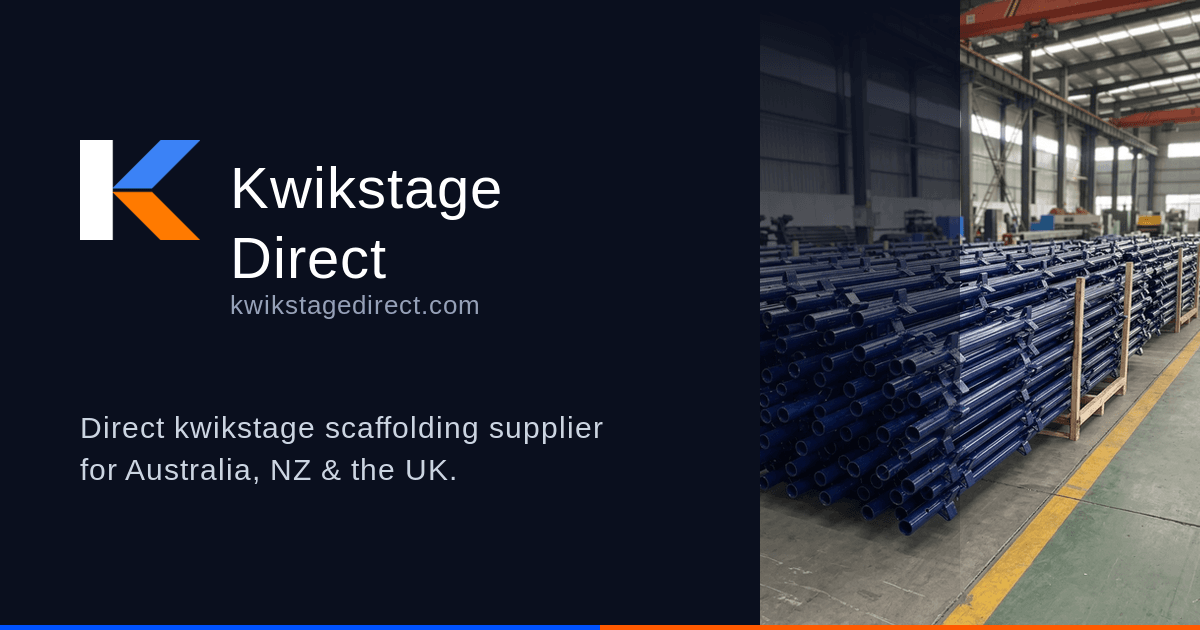
For scaffolding procurement teams, distributors, and temporary works engineers, the regulatory landscape has shifted significantly in 2026. The widespread adoption and enforcement of the TG30:24 System Scaffolding Guidance by the National Access and Scaffolding Confederation (NASC) has fundamentally altered how Kwikstage scaffolding is sourced, documented, and deployed on site.
Historically, system scaffolding like Kwikstage operated in a regulatory grey area compared to traditional tube and fitting scaffolding (which has long been governed by the strict parameters of TG20). Contractors often had to choose between paying for expensive, site-specific engineering designs for relatively standard erections, or relying heavily on manufacturer manuals that site inspectors found difficult to audit.
TG30:24 changes the game. It provides a standardized method for generating compliance sheets for modular systems, standardizing the proof of safety. However, this convenience on the job site creates a strict new mandate for the supply chain. If the Kwikstage components you procure do not meet the stringent material and dimensional tolerances assumed by the TG30 software, your compliance sheets are void, leaving your firm exposed to massive legal liability and the hidden costs of bespoke engineering.
Key Executive Takeaways:
- Standardization Reduces Costs: Properly sourced Kwikstage allows sites to use TG30 Compliance Sheets, saving thousands in bespoke engineering fees.
- Supply Chain Transparency is Mandatory: You can no longer buy "generic" Kwikstage based solely on price; MTCs, third-party tests, and dimensional audits are non-negotiable.
- The Trap of Cheap Steel: Substandard yield strength (e.g., passing off Q235 as Q355) instantly invalidates TG30 assumptions, risking catastrophic failure.
Fast procurement path for this article:
- If you need vertical standards with documented steel grade and node fit-up, start with the Kwikstage standards sourcing page.
- If your quote includes mixed fleet compatibility or replacement stock, review the compatible scaffold systems guidance.
- If you are buying a bundled job package, compare assumptions against the Kwikstage package planning page before asking for a compliance evidence pack.
1. The Economic Shift: Bespoke Design vs. TG30 Compliance
To understand the sourcing impact, buyers must first understand the financial mechanics of site compliance. When scaffolding is erected, the principal contractor and site safety inspectors require proof that the structure will hold the required load (e.g., 2 kN/m² for general purpose) under local wind conditions.
Before TG30, if a Kwikstage configuration deviated even slightly from the basic manufacturer handbook, site managers had to commission a temporary works engineer to draft a bespoke calculation. At £500 to £1,500 per design, multiplied by dozens of erections across a large commercial project, these engineering fees rapidly eroded margins.
TG30:24 allows contractors to use an eGuide to generate a compliance sheet for standard structures (now including complex birdcages as of the mid-2026 updates). This sheet proves compliance instantly, for free, provided the materials used match the assumed structural profile.
This shifts the burden of proof from the site engineer to the procurement department. Buying non-compliant scaffolding that falls outside TG30 tolerances means forcing your operations team back into the expensive bespoke design loop.
Scope note for global buyers: TG30 is a UK NASC route for recognised system-scaffold configurations. It is still useful to exporters, distributors, and multinational contractors because it exposes the evidence a competent reviewer will ask for, but it does not replace local law in Australia, New Zealand, the EU, the Gulf, or any project jurisdiction. Treat it as a compliance evidence benchmark, not a universal permit to erect.
| Factor | TG30:24 Compliance Sheet | Bespoke Engineering Design |
|---|---|---|
| Direct Cost | Virtually Zero (included in eGuide subscription) | High (£500 - £2,000+ per unique erection) |
| Turnaround Time | Instant (Software generated) | Days to Weeks (Subject to engineer availability) |
| Component Requirements | Must strictly adhere to assumed high-tensile standards | Can accommodate sub-standard material via reduced SWL |
| Applicability Scope | Standard independents, towers, and specific birdcages | Unlimited (complex cantilevers, bridges, extreme heights) |
| Procurement Risk | High: Buying poor quality voids the sheet entirely | Low: Engineer calculates around the weak material |
| Site Sign-Off | Standardized, easily accepted by generic inspectors | Requires detailed cross-referencing with drawings |
| System Mixing | Strictly prohibited without specific test data | Permitted if engineer calculates mixed load paths |
2. What Procurement Teams Must Demand from Suppliers
To protect the ability to use TG30 compliance sheets, buyers must enforce strict quality control measures at the factory level. You are no longer just buying steel tubes and wedges; you are buying the mathematical certainty that those components will perform exactly as the TG30 software assumes.
There are three primary areas where substandard manufacturing will compromise compliance: material yield strength, dimensional tolerances (fit-up), and weld integrity.
Material Yield Strength: The Q235 vs Q355 Trap
Kwikstage vertical standards must bear immense compressive loads. The TG30 mathematical models assume these uprights are manufactured from high-tensile steel, typically European S355 or its Chinese equivalent, Q345/Q355, yielding at approximately 355 MPa.
A common trap for procurement teams chasing the lowest price per ton is purchasing Kwikstage manufactured entirely from Q235 (mild carbon steel, yielding at ~235 MPa). While Q235 is perfectly acceptable for ledgers and transoms (which bear primarily bending moments rather than pure compression), using Q235 for vertical standards reduces the Safe Working Load (SWL) by nearly 30%. If a site manager prints a TG30 compliance sheet assuming Q355 strength, but the structure is built with Q235 standards, the entire scaffold is critically non-compliant and legally dangerous.
A practical purchase-order control is to separate component classes: specify Q345/Q355 or S355-equivalent material for vertical standards, require matching heat numbers on the MTCs, and make any lower-grade ledger or transom substitution explicit instead of hidden inside a blended bill of materials.
Weld Penetration and Node Integrity
The Kwikstage V-pressings (star nodes) welded to the standards at 500mm intervals are the critical failure points of the system. TG30 models assume rigid, consistent node connections. Factories utilizing manual, uncalibrated welding processes often produce superficial welds with poor penetration. Buyers must insist on automated robotic welding for V-pressings and demand macro-etch test reports proving full weld penetration.
Surface Treatment & Lifespan Tracking
Compliance is not just about the day the scaffolding arrives; it is about how it performs five years later. TG30 calculations assume components have not lost structural integrity to rust. In 2026, the industry standard for long-term compliance is Hot-Dip Galvanization (HDG) to a minimum zinc thickness of 80 microns (µm). Painted Kwikstage, while cheaper initially, requires constant visual inspection and risks compliance failure if internal tube corrosion goes unnoticed.
The TG30:24 Compliant Sourcing Workflow
3. 2026 Updates: Birdcages and Extended Configurations
A significant development in mid-2026 was the expansion of the TG30 suite to cover highly complex birdcage configurations across cup, wedge, and rosette systems. Previously, large volume birdcages—often used for ceiling access in commercial builds or falsework support—almost universally required bespoke temporary works designs due to the complex load distributions across multiple bays.
The updated guidance now provides pre-calculated parameters for freestanding, tied, and butted birdcages. For procurement, this is a massive operational win. It means that the standard stock of 2.4m and 1.8m ledgers and transoms can be deployed into massive birdcage structures with zero engineering friction, provided the inventory meets the baseline TG30 requirements.
This update places even more emphasis on purchasing standardized, high-quality stock. If your inventory consists of mixed brands, varying steel grades, or bent components, the site manager cannot legally use the new birdcage compliance sheets, neutralizing the biggest efficiency gain of the 2026 update.
4. The Sourcing Checklist: 8 Steps to TG30-Ready Kwikstage
Whether importing directly from overseas manufacturers or buying from local stockists, procurement teams should use this checklist to ensure the Kwikstage they acquire supports TG30 compliance:
TG30:24 Factory Audit & Procurement Checklist
- ✓Specify Q355 for Standards: Explicitly stipulate Q345 or Q355 high-tensile steel on purchase orders for all vertical standards. Do not accept Q235.
- ✓Demand MTC Verification: Require Mill Test Certificates for every raw steel batch used in your production run, verifying yield and tensile strengths.
- ✓Confirm Robotic Welding: Audit the factory to ensure structural nodes (V-pressings) are robotically welded for consistent penetration, preventing node shear.
- ✓Third-Party Load Testing: Request independent load testing reports (e.g., from SGS or Lloyds) proving the assembled node connections match expected TG30 capacity.
- ✓HDG Thickness Verification: If purchasing galvanized stock, mandate a minimum zinc coating of 80µm to prevent internal corrosion that invalidates compliance over time.
- ✓Dimensional Tolerances: Establish a strict ± tolerance for tube straightness and wedge fit-up. Poor fit-up introduces eccentricity into the load path, voiding standard calculations.
- ✓Traceability Stamping: Ensure all components are physically stamped with a heat number or batch ID, allowing site managers to trace the steel back to the MTC if challenged by an inspector.
- ✓Digital Tracking Readiness: Consider purchasing components pre-fitted with ruggedized RFID tags to seamlessly integrate into modern digital compliance and inventory platforms.
5. The Boundaries: When TG30 Does Not Apply
While the goal of procurement is to buy materials that maximize the use of free TG30 compliance sheets, it is equally important to understand the boundaries. TG30:24 is not a magic bullet for every scenario.
Procurement and engineering teams must communicate clearly when a project involves:
- Extreme Heights: Structures exceeding the maximum height parameters defined in the specific system's compliance criteria.
- High Wind Exposure: Scaffolds erected in severe topographical environments (e.g., cliff edges, coastal exposure) that fall outside the standard wind load tables.
- Heavy Duty Loading: Specialized applications requiring load capacities beyond standard masonry or general purpose limits.
- Cantilevers and Bridges: Complex load paths that require detailed node-by-node structural analysis.
In these scenarios, no matter how high-quality the Kwikstage inventory is, a bespoke temporary works design is legally mandated. The advantage of having high-quality, fully documented stock in these cases is that the temporary works engineer can confidently assign maximum SWLs to the components, resulting in a more efficient, less conservative design.
Conclusion: Procurement as a Safety Function
In 2026, the line between commercial procurement and site safety has vanished. Purchasing decisions directly dictate whether a site can utilize the streamlined, cost-effective TG30:24 compliance pathways, or whether they will be bogged down in delays, bespoke engineering fees, and failed inspections.
By insisting on verifiable steel grades, robotic welding, and complete traceability, buyers not only protect their company's bottom line but actively prevent structural failures on site.
Source TG30-Ready Kwikstage Direct
Don't let substandard imports put your site compliance at risk. Kwikstage Direct supplies fully traceable, Q355 high-tensile standards and robotically welded components that support standard compliance sheets.
Request MTCs and PricingSources & References
- 1. National Access and Scaffolding Confederation (NASC): ePortal for TG20 and TG30 compliance sheets
- 2. NASC: TG30 updated with new cup, wedge, and rosette birdcage configurations
- 3. Health and Safety Executive (HSE): Scaffolding Checklist & Safety Information
- 4. BSI Knowledge: BS EN 12811-1:2003 temporary works equipment, scaffolds, performance requirements and general design